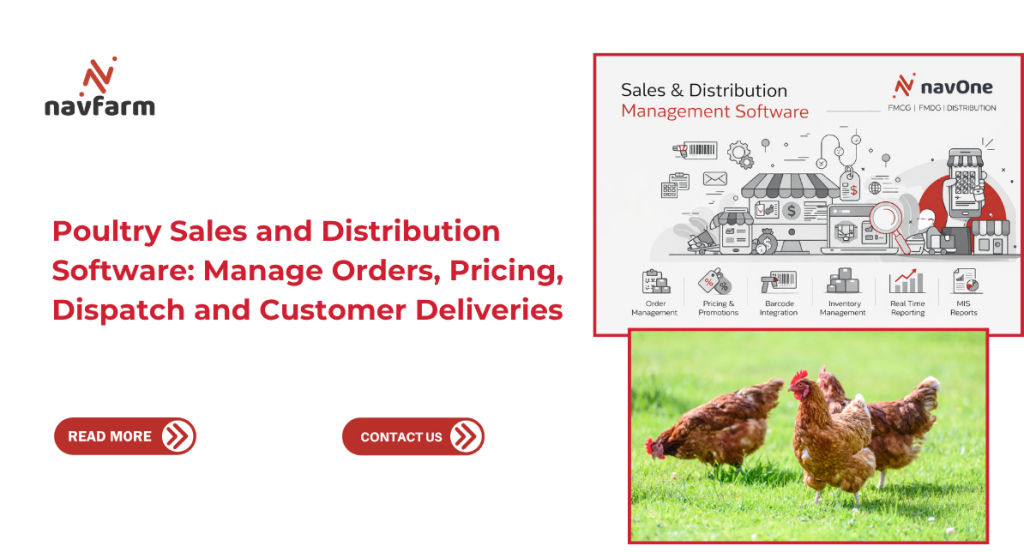
Poultry Sales and Distribution Software: Manage Orders, Pricing, Dispatch and Customer Deliveries

Book a Free Demo

Sales in a Poultry Business Starts Before the Product Is Ready

Sales in a poultry business is different from selling many other products.

A customer may place an order today for birds, chicks, eggs or processed chicken that needs to be supplied several days or weeks later. The sales team accepts the requirement, but actual fulfilment depends on what is happening across farms, hatcheries, warehouses and processing operations.

This creates a practical challenge.

The sales team needs to know what can be supplied.

If that information is not available, orders may be accepted based on assumptions.

A broiler batch may not reach the expected weight on time.

A hatchery may produce fewer chicks than planned.

Egg production may be below forecast.

Mortality may reduce the available bird population.

Processing yield may affect finished product availability.

Some stock may already be committed to another customer.

The result is a gap between what sales has promised and what operations can deliver.

Poultry Sales and Distribution Software helps connect customer demand with actual product availability, production, inventory and dispatch.

For an integrated poultry business, this connection is important because sales should not operate separately from production.

Why Poultry Sales Management Becomes Difficult as the Business Grows

A small poultry operation may be able to manage customer orders through phone calls, WhatsApp, Excel and manual invoices.

The same approach becomes difficult when the business starts managing multiple farms, products, customers and delivery locations.

A growing poultry company may sell:

  • Day old chicks
  • Broiler birds
  • Live birds
  • Table eggs
  • Hatching eggs
  • Processed chicken
  • Whole chicken
  • Chicken cuts
  • Frozen products
  • Feed
  • Other poultry products

Each product has its own availability, pricing, inventory and delivery requirements.

The sales team may also deal with distributors, wholesalers, retailers, hotels, restaurants, institutional customers and direct customers.

When this information is spread across different systems and spreadsheets, sales planning becomes difficult.

A dedicated poultry sales management system gives the business one place to manage the complete process from customer requirement to delivery.

Customer Orders Should Be Connected with Actual Availability

One of the most important questions for a sales team is simple.

Can we supply this order on the required date?

Answering that question is not always simple in poultry.

Availability may depend on current inventory as well as expected future production.

For example, a customer may request 20,000 broiler birds for delivery next week.

The system should help the business understand:

Current bird population

Farm and batch

Bird age

Expected mortality

Expected average weight

Expected production date

Birds already committed to other customers

Available quantity

Planned dispatches

This gives the sales and operations teams a much better basis for confirming the customer order.

Poultry Order Management Should Start with the Customer Requirement

Every customer order should capture the information required for fulfilment.

Depending on the product, this may include:

  • Customer name
  • Product
  • Quantity
  • Grade
  • Size
  • Weight
  • Breed
  • Delivery date
  • Delivery location
  • Price
  • Payment terms
  • Special instructions
  • Packaging requirement
  • Quality requirement

The order then becomes the starting point for planning rather than remaining only a sales document.

Operations can see what customers are expecting and when the product needs to be available.

Customer Orders Can Drive Poultry Production Planning

This is where a connected poultry ERP becomes more useful than a standalone sales application.

Confirmed customer demand can influence production planning.

Suppose customers have placed orders for a certain number of birds over the next few weeks.

Management can compare the demand with expected farm output.

If demand is higher than expected production, the business gets an early indication of a potential shortage.

If expected production is significantly higher than confirmed and forecast demand, management can also see the risk of excess availability.

The same principle can be applied across different poultry operations.

Customer demand can influence:

  • Chick placement
  • Farm planning
  • Broiler production
  • Egg production planning
  • Hatchery planning
  • Processing planning
  • Feed requirements
  • Inventory planning
  • Dispatch planning

Sales therefore becomes part of the operational planning process rather than an activity that happens after production.

Sales Planning for Day Old Chicks

Day old chick sales require careful coordination between sales and hatchery operations.

A customer may book chicks in advance for a particular delivery date.

The business needs to understand whether the expected hatch can meet the requirement.

The sales and hatchery teams may need visibility into:

  • Customer orders
  • Required DOC quantity
  • Breed
  • Delivery date
  • Hatch plan
  • Egg setting
  • Expected hatchability
  • Expected chick output
  • Already committed quantity
  • Expected available chicks

If customer demand is connected with hatchery planning, the business can identify shortages before the hatch date.

This is much better than finding out on the day of dispatch that the required quantity is not available.

Customer Orders Can Support Hatchery Demand Planning

For an integrated poultry company, demand planning can work backwards from the customer requirement.

If the business knows how many chicks customers require, it can estimate the number of chicks that need to be produced.

That requirement can then be connected with expected hatchability and the number of hatching eggs required.

This creates a planning chain between:

  • Customer demand
  • Chick requirement
  • Hatchery requirement
  • Hatching egg requirement
  • Breeder production

The sales order is therefore not just used for invoicing. It can provide useful information for future production planning.

Egg Sales Need Production Visibility

Egg sales have a different challenge.

Production happens daily, while customer demand can change.

The sales team needs to know:

  • Current egg stock
  • Today’s production
  • Expected production
  • Egg grade
  • Egg size
  • Farm
  • Batch or flock
  • Committed quantity
  • Available quantity
  • Customer demand
  • Expected dispatch

For layer businesses, connecting egg production with sales orders can help management understand whether future demand can be met.

This becomes particularly important when the business manages several layer farms or sells multiple egg grades.

Egg Production Forecast Can Help the Sales Team

Historical production and current flock information can be used to estimate expected egg availability.

The business can compare:

  • Expected egg production
  • Current customer orders
  • Forecast demand
  • Existing inventory
  • Committed quantity
  • Expected available quantity

This allows sales teams to work with a more realistic view of future availability.

If a shortage is expected, the business has time to review customer priorities or adjust the supply plan.

If excess production is expected, the sales team can focus on additional demand before the stock becomes difficult to manage.

Broiler Sales Need Farm and Batch Visibility

Broiler sales depend heavily on farm performance.

The number of birds originally placed is not necessarily the number available for sale.

Mortality changes the population.

Bird growth affects the expected selling date.

Average body weight affects the total saleable weight.

The sales team should therefore have visibility into information such as:

  • Farm
  • House or shed
  • Batch
  • Placement quantity
  • Current bird population
  • Bird age
  • Mortality
  • Average body weight
  • Expected harvest date
  • Expected saleable quantity
  • Committed quantity
  • Available quantity

This makes order confirmation more reliable.

Selling by Bird and Selling by Weight Are Different

Poultry businesses may sell live birds by no., weight or a combination of both.

A customer may request a specific number of birds within a particular weight range.

Another customer may purchase based on total kilograms.

The sales system should support the commercial unit used by the business.

This is important because the quantity at the farm and the final invoiced quantity may not always be represented in the same way.

Poultry Processing Sales Need Finished Product Visibility

For a poultry processing business, sales becomes more complex because one bird can result in several finished products.

The plant may sell:

  • Whole chicken
  • Breast
  • Wings
  • Legs
  • Drumsticks
  • Thighs
  • Other cuts
  • Fresh products
  • Frozen products

The sales team needs to know what finished products are currently available and what is expected from upcoming processing.

A customer order for breast meat, for example, cannot be treated only as a total chicken requirement.

Processing yield and product mix also matter.

Sales Orders Can Help Plan Poultry Processing

Customer orders can provide the processing plant with a clearer view of what needs to be produced.

The processing team can review:

  • Customer demand
  • Product requirement
  • Required quantity
  • Current finished stock
  • Available live birds
  • Expected bird weight
  • Processing capacity
  • Expected yield
  • Packaging requirements
  • Required dispatch date

This allows production to be planned around actual market requirements.

It can also help reduce unnecessary finished stock.

Available Stock and Available to Promise Are Not the Same

A warehouse may physically have 10,000 units of a product.

That does not necessarily mean all 10,000 units can be sold.

Some stock may already be reserved for confirmed orders.

Some may be blocked by quality.

Some may be close to expiry.

Some may be allocated to another location.

Sales therefore needs to understand actual available stock rather than only total stock.

A connected poultry order management system can provide visibility into:

  • Total stock
  • Reserved stock
  • Blocked stock
  • Quality hold stock
  • Available stock
  • Committed stock
  • Expected production

This helps reduce over commitment.

Customer Specific Pricing Needs Proper Control

Poultry pricing can vary by customer.

The selling price may depend on:

  • Product
  • Customer
  • Quantity
  • Market
  • Location
  • Weight
  • Grade
  • Contract
  • Sales channel
  • Delivery terms
  • Current market price

The business may also provide special rates to large customers or distributors.

If pricing is managed through individual spreadsheets or messages, errors can happen.

A poultry sales management system can maintain customer specific pricing rules and provide better control during order entry.

Price Changes Should Be Controlled

Poultry prices can change frequently.

Management may need to revise prices based on feed cost, market conditions, bird availability or other commercial factors.

The system should maintain a clear record of:

  • Current price
  • Effective date
  • Customer specific price
  • Previous price
  • Discount
  • Approved special price

This gives management more control over pricing decisions.

Discount Approval Can Protect Margin

Sales teams sometimes need to provide a special discount to close an order.

The issue is not the discount itself.

The issue is whether the discount is commercially acceptable.

An approval process can be used when the selling price falls below an agreed level.

Depending on company policy, the order can be routed to the sales manager, finance team or management for approval.

This helps the business maintain pricing discipline.

Sales Price Should Be Compared with Production Cost

A high sales volume does not always mean good profitability.

The selling price should be considered together with the actual or expected production cost.

For example, if feed cost has increased significantly, the cost of producing a broiler may also increase.

If the sales team continues using an old selling price, the margin can fall without being immediately visible.

A connected poultry ERP can help management compare:

Selling price

Production cost

Cost per bird

Cost per kg

Processing cost

Gross margin

This gives the business better information before making pricing decisions.

Customer Wise Profitability Gives a Better Commercial Picture

Two customers buying the same product may generate different margins.

One may receive a higher discount.

Another may require special packaging.

A distant customer may involve higher transportation cost.

Another customer may purchase regularly in large volumes.

Customer profitability can therefore be reviewed using:

  • Sales value
  • Product cost
  • Discount
  • Freight
  • Other applicable costs
  • Gross profit
  • Margin

This helps management understand which customers and channels are contributing more to the business.

Poultry Dispatch Planning Should Start Before the Vehicle Arrives

Dispatch should not begin when the truck reaches the farm or warehouse.

The dispatch team should already know:

  • Which customer is being supplied
  • What product is required
  • Required quantity
  • Source location
  • Batch
  • Dispatch date
  • Delivery location
  • Vehicle requirement
  • Loading requirement
  • Documents required

This makes the dispatch process easier to manage.

Farm to Customer Dispatch

Some poultry businesses dispatch birds directly from farms.

In this case, the sales order should be connected with the farm and batch from which the birds will be supplied.

The dispatch transaction can capture:

  • Customer
  • Farm
  • Batch
  • Bird quantity
  • Average weight
  • Total weight
  • Vehicle
  • Dispatch date
  • Destination

The dispatched quantity should then reduce the relevant farm or batch availability.

Warehouse to Customer Dispatch

For eggs, processed products and other inventory items, dispatch may take place from a warehouse.

The system can help the dispatch team select the appropriate stock based on:

Product

Location

Batch

Lot

Production date

Expiry date

Quality status

Customer requirement

This improves stock control and product traceability.

Batch and Lot Traceability Should Continue Through Sales

Traceability should not stop when production is completed.

The business should know which batch or lot was supplied to each customer.

This becomes important if a quality complaint is received later.

The company should be able to trace a customer delivery back to the relevant:

Finished product batch

Processing batch

Farm

Flock

Feed or other production information where required

The exact traceability chain will depend on the poultry operation.

Keeping sales and dispatch connected with batch information makes this investigation much easier.

Expiry and Shelf-Life Matter in Poultry Distribution

Fresh and frozen poultry products require proper shelf life management.

The sales and warehouse teams need visibility into production and expiry dates.

The system can help identify:

Stock approaching expiry

Older stock

Available shelf life

Customer specific shelf life requirements

Blocked stock

This can help the business plan dispatch more carefully and reduce avoidable expiry losses.

Delivery Planning Is Part of Poultry Distribution

Customer delivery is another important part of sales fulfilment.

The business may operate its own vehicles or use third party transporters.

Delivery planning may consider:

Customer location

Delivery date

Order quantity

Vehicle capacity

Product type

Temperature requirement

Route

Multiple customer deliveries

The objective is to make sure the correct product reaches the correct customer at the required time.

Vehicle and Transport Details Can Be Linked with Dispatch

The dispatch record can include transport information such as:

Vehicle number

Driver

Transporter

Dispatch time

Destination

Quantity

Weight

Delivery document

This creates a better record of the movement from farm, hatchery, processing plant or warehouse to the customer.

Cold Chain Visibility Is Important for Processed Poultry

Processed poultry requires additional control during storage and distribution.

Fresh and frozen products may have defined temperature requirements.

The business may need to maintain temperature related information at different stages depending on its quality and compliance process.

Connecting product batch, storage location and dispatch information can provide better visibility during distribution.

Returns and Rejections Need Proper Tracking

Not every delivery is accepted completely.

Customers may reject products because of:

Quantity difference

Weight difference

Quality

Packaging

Damage

Temperature

Expiry

Incorrect product

Other commercial reasons

The return should be recorded against the original transaction.

This helps the business understand why returns are happening and whether the issue is related to production, quality, warehouse or distribution.

Customer Complaints Should Be Connected with Sales History

When a customer reports a problem, the sales team should not have to search through multiple files to identify the original delivery.

The system should provide access to:

Customer

Invoice

Sales order

Dispatch

Product

Batch

Quantity

Delivery date

This information can then support the quality investigation.

For a poultry business, this connection between customer complaint and product traceability can be very important.

Credit Control Is Also Part of Sales Management

Sales teams naturally focus on getting orders.

Finance teams also need to consider whether the customer is paying on time.

Before confirming additional sales, the business may need visibility into:

Customer credit limit

Outstanding amount

Overdue invoices

Payment terms

Available credit

An integrated poultry ERP can bring sales and financial information together so that commercial decisions are not made without considering customer exposure.

Sales Order to Invoice Should Be Connected

Once the product is dispatched, the relevant sales information should flow into invoicing.

This reduces repeated data entry.

The process can connect:

Customer order

Dispatch

Delivered quantity

Actual weight

Sales price

Invoice

Customer account

Finance

For weight based poultry sales, the final invoice may need to consider the actual dispatch or delivered weight according to the company’s commercial process.

Sales Returns Should Update Inventory and Finance

When material is returned, both stock and financial information may be affected.

The system should maintain a proper link between the return and the original customer transaction.

This helps maintain accurate inventory and customer balances.

Sales Teams Need Real Time Information

A salesperson speaking with a customer should not have to call the farm, hatchery, warehouse and finance department before answering every question.

The sales team should have access to the information relevant to their role.

For example:

Available products

Expected production

Open orders

Customer prices

Customer outstanding

Dispatch status

Order history

This improves the quality and speed of customer communication.

Mobile Sales Can Help Teams Working in the Market

Salespeople are not always sitting in an office.

A mobile based process can allow authorised users to review or capture information while visiting customers.

Depending on the business process, mobile functionality can support:

Customer enquiry

Order entry

Product availability

Price information

Order status

Customer history

Collection information

This can reduce the delay between receiving an order and entering it into the system.

Management Needs a Clear View of Sales Performance

Management should be able to understand sales without waiting for several reports to be combined manually.

A poultry sales dashboard can show:

Sales today

Sales this week

Sales this month

Open customer orders

Pending dispatches

Sales by product

Sales by customer

Sales by location

Sales by salesperson

Average selling price

Order fulfilment

Returns

Customer outstanding

Sales margin

The exact dashboard should depend on what management actually needs to monitor.

Sales Versus Production Is an Important Poultry Report

One of the most useful reports for an integrated poultry business is the comparison between expected production and expected sales.

For example, management can review the coming weeks and see:

Expected broiler availability

Confirmed broiler orders

Expected DOC production

Confirmed DOC orders

Expected egg production

Confirmed egg orders

Expected processed product availability

Confirmed sales demand

This helps identify shortages and excess production earlier.

Sales Forecast Can Improve Future Planning

Confirmed orders tell the business what customers have already requested.

Forecasting helps estimate what customers may require in the future.

The business can use sales history, current orders, seasonal patterns and management input to prepare a demand forecast.

That forecast can then support future production planning.

This is particularly valuable in poultry because production cannot be increased instantly.

Birds require time to grow.

Hatching requires planning.

Egg production follows the flock cycle.

Feed needs to be arranged.

Farm capacity has limits.

Better demand visibility therefore gives operations more time to prepare.

Multi Location Poultry Sales Need Central Visibility

A poultry company may operate several farms, hatcheries, processing plants, warehouses and sales locations.

A customer order may be fulfilled from one location today and another location next week.

Management needs central visibility into:

Orders

Stock

Expected production

Available birds

Egg availability

Chick availability

Finished products

Dispatch

Sales

This helps the business use available production more effectively across locations.

Distribution Stock Should Be Visible Separately

Some poultry businesses maintain stock at distribution centres or regional warehouses.

The business should know what inventory is available at each location.

This allows sales teams to understand whether a customer can be supplied locally or whether stock needs to be transferred from another location.

This can also help reduce unnecessary transportation.

Sales and Inventory Should Work Together

Sales and inventory cannot be managed independently.

Every confirmed and dispatched order affects availability.

At the same time, inventory information affects what sales can promise.

A connected system should provide a clear relationship between:

Customer demand

Available inventory

Reserved inventory

Expected production

Transfer orders

Dispatch

Remaining availability

This is particularly important for products with a short shelf life.

Sales and Procurement Can Also Be Connected

Sales demand can influence purchasing requirements.

For example, higher processed chicken demand may increase requirements for:

Packaging material

Labels

Cartons

Other consumables

A connected planning process can use demand information to support procurement decisions.

Sales and Finance Need the Same Customer Information

Sales may look at order value and volume.

Finance may look at outstanding payments and profitability.

Management needs both.

A connected poultry ERP can provide a common customer record for sales and finance.

This reduces differences between operational and financial reporting.

Order Fulfilment Should Be Measured

Receiving an order is only the beginning.

The business should also measure how effectively it fulfils customer commitments.

Management can monitor:

Ordered quantity

Supplied quantity

Pending quantity

Required delivery date

Actual delivery date

Cancelled quantity

Rejected quantity

This gives a better picture of customer service performance.

Why Separate Sales and Farm Systems Create Problems

If sales is managed in one system and farm operations in another, teams often depend on manual communication.

Sales asks operations about availability.

Operations sends an Excel report.

The report becomes outdated.

Sales accepts another order.

Production changes.

The available quantity changes again.

The problem is not that people are not communicating.

The problem is that everyone is working with different information.

Connecting sales with poultry operations reduces this gap.

How NAVFarm Supports Poultry Sales and Distribution

NAVFarm is designed to connect poultry operations with the commercial side of the business.

Depending on the poultry business model, NAVFarm can connect sales and distribution with:

Customer management

Customer orders

Product availability

Farm and batch information

DOC availability

Egg production

Broiler availability

Processing

Finished goods inventory

Customer pricing

Dispatch

Batch and lot traceability

Sales returns

Inventory

Production planning

Finance

Management reporting

NAVFarm works with Microsoft Dynamics 365 Business Central, allowing operational poultry information to work together with sales, inventory, purchasing and financial transactions.

This is particularly useful for integrated poultry companies where customer demand needs to be connected with farms, hatcheries, feed operations or processing plants.

A Practical Customer Order Example

Consider an integrated poultry company selling broilers.

A customer requests 25,000 birds for delivery next week.

The sales team enters the requirement.

The system provides visibility into the batches expected to reach the required age and weight.

One farm is expected to have 15,000 saleable birds.

Another farm is expected to have 13,000.

Some birds from the second farm are already committed to another customer.

The available quantity is therefore checked before the order is confirmed.

The dispatch plan is prepared against the selected farms and batches.

At dispatch, actual bird quantity and weight are recorded.

The sales transaction is completed and the financial information is updated.

Management can later review the order, farm source, quantity, selling price and profitability.

This is very different from accepting the order first and trying to identify available birds later.

A Day Old Chick Sales Example

A customer books 50,000 day old chicks for a future date.

The requirement becomes visible to the hatchery planning team.

The team can compare customer demand with expected chick output.

If expected output is below the committed quantity, the shortage is visible before the hatch date.

The business can then review the plan instead of dealing with the shortage at dispatch.

This is where connecting sales with poultry production creates real operational value.

A Processed Chicken Sales Example

A customer places an order for multiple chicken cuts.

The sales team checks available finished stock.

The remaining requirement becomes part of the processing demand.

The processing team can review the required product mix, available live birds and expected yield.

After production, finished stock is allocated to the order.

The warehouse prepares the dispatch.

The relevant batches remain connected with the customer delivery.

The invoice is generated from the completed sales transaction.

The same customer demand is therefore visible from planning through dispatch.

What to Look for in Poultry Sales and Distribution Software

Before selecting poultry sales management software, a poultry company should check whether the system supports its actual business model.

Important capabilities may include:

Customer order management

Customer specific pricing

Product availability

Farm and batch availability

Chick sales

Egg sales

Live bird sales

Processed poultry sales

Inventory allocation

Order reservation

Dispatch planning

Batch and lot traceability

Expiry management

Customer returns

Credit control

Sales invoicing

Sales profitability

Multi location operations

Mobile access

Production integration

Finance integration

The right system should connect sales with the parts of the poultry business responsible for fulfilling the order.

Frequently Asked Questions

What is Poultry Sales and Distribution Software

Poultry Sales and Distribution Software helps poultry businesses manage customer orders, product availability, pricing, dispatch, deliveries, returns and sales reporting while connecting these activities with poultry operations.

Can poultry sales software show available birds by farm

Yes. When farm and sales information are connected, the sales team can review relevant farm and batch information such as bird population, age, expected availability and committed quantity.

Can the software manage day old chick orders

Yes. Customer DOC orders can be recorded and connected with hatchery planning and expected chick availability.

Can poultry software manage egg sales

Yes. Egg inventory, production information, customer demand, pricing and dispatch can be managed within a connected poultry business process.

Can it manage processed chicken sales

Yes. Sales orders can be linked with finished product inventory, processing requirements, batch information, packaging and dispatch.

Can poultry sales software manage customer specific prices

Yes. Customer specific pricing, effective dates, discounts and approval requirements can be maintained according to the company’s sales policy.

Can poultry sales be connected with production planning

Yes. Customer orders and demand information can provide input for farm, hatchery, processing and other production planning activities.

Can the system maintain poultry product traceability after sale

Yes. Batch or lot information can remain connected with the sales and dispatch transaction so the business can identify which product was supplied to a particular customer.

Can NAVFarm connect sales with accounting

Yes. NAVFarm works with Microsoft Dynamics 365 Business Central, allowing sales, inventory, purchasing and financial information to work with poultry operational processes.

When Sales and Production Work from the Same Information

The biggest benefit of a connected poultry sales system is not simply faster order entry.

It is better coordination.

Sales knows what operations can supply.

Farms know what customers will require.

Hatcheries can see future chick demand.

Processing teams can see the product mix customers are ordering.

Warehouses know what needs to be dispatched.

Finance can see the commercial and financial position of the customer.

Management can compare demand, production, sales and profitability without waiting for several spreadsheets to be combined.

For a growing poultry company, this becomes increasingly important as the number of farms, customers, products and locations increases.

NAVFarm connects poultry operations with sales, distribution, inventory and financial management through Microsoft Dynamics 365 Business Central.

For poultry businesses still managing customer orders, farm availability and dispatch through separate Excel files, calls and messages, moving to a connected Poultry Sales and Distribution Software can provide much better control over the complete order to delivery process. To understand how NAVFarm can be configured for your poultry business, request a NAVFarm demonstration based on your actual farm, hatchery, processing, sales and distribution process.

Book a Free Demo