Pradeep
By NAVFarm Team |Poultry Farm Management|6-min read
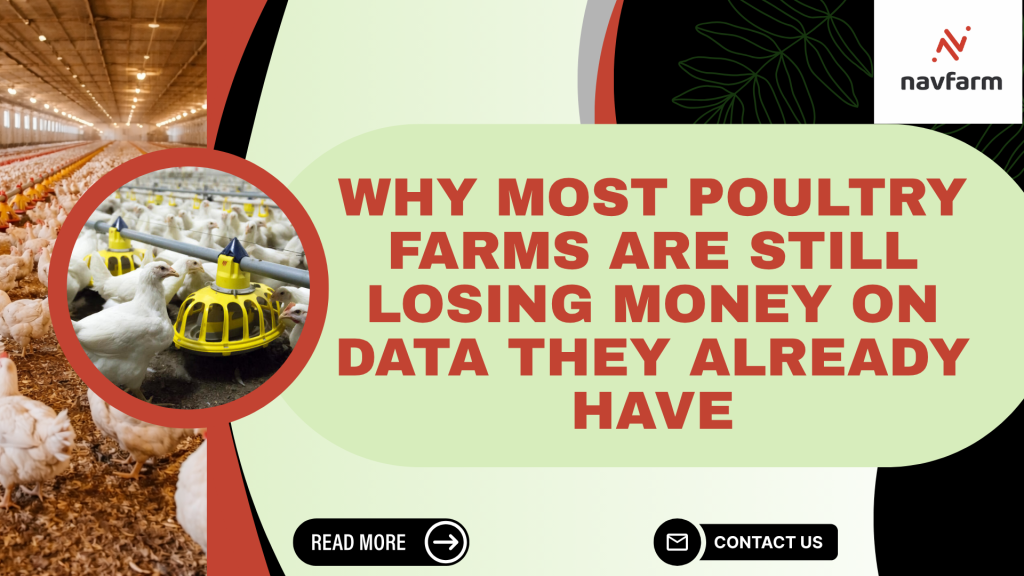
Whether you manage a poultry farm with 10,000 birds or 500,000, the daily routine is familiar. Every morning begins with shed inspections, mortality counts, feed consumption checks, water intake monitoring, and observations of bird health and behavior. Most of this information gets recorded in notebooks, spreadsheets, or WhatsApp messages.
The problem is that by the time this data reaches decision-makers, valuable time has already been lost. Even worse, many farms never fully use the information they collect. As a result, important decisions continue to rely heavily on experience and instinct rather than real-time insights.
The poultry farms that will succeed over the next decade are not necessarily the largest. They are the farms that understand their numbers and act on them quickly using modern Poultry Farm Management Software.
The Hidden Cost of Disconnected Farm Management
When a flock underperforms, managers often spend days reviewing feed records, checking environmental conditions, consulting veterinarians, and searching for possible causes.
This delay comes at a cost.
For many mid-sized poultry operations, disconnected systems can result in:
- Higher feed conversion ratios due to missed feeding adjustments.
- Delayed veterinary interventions because no automated alerts exist.
- Vaccination gaps across multiple sheds and batches.
- Limited traceability when buyers request production records.
- Compliance challenges during audits due to incomplete records.
These problems are rarely caused by poor farming practices. More often, they occur because farms lack a centralized Poultry Management Solution that connects all critical information in one place.
What Farm-to-Fork Traceability Really Means
Farm-to-fork traceability is frequently discussed in the poultry industry, but many farms still struggle to implement it effectively.
True traceability means being able to provide documented evidence of everything that happened throughout a flock’s lifecycle—from chick placement to final dispatch.
This includes:
- Batch identification and placement dates.
- Complete vaccination schedules and records.
- Feed sources, quantities, and feeding program changes.
- Veterinary treatments and health events.
- Environmental conditions throughout the grow-out period.
- Final production performance, including mortality rates and FCR.
With a reliable Poultry Farm Management Software system, all of this information becomes searchable, organized, and available when needed.
This level of visibility helps poultry businesses:
- Meet buyer and processor traceability requirements.
- Improve food safety and compliance standards.
- Identify top-performing breeds and suppliers.
- Strengthen their position during audits and inspections.
The Limitations of Spreadsheets and WhatsApp Groups
Spreadsheets have served poultry farms for many years, but they were never designed to manage complex multi-flock operations.
As farms grow, common challenges begin to appear:
- Data entry errors that remain unnoticed for weeks.
- No automatic alerts when key performance indicators move outside acceptable ranges.
- Difficulty comparing flock performance across multiple batches.
- Loss of knowledge when the person managing the spreadsheet leaves.
- No connection between health records, procurement, feed management, and production data.
Over time, these inefficiencies increase operational costs through lower flock performance, higher medication use, and reduced productivity.
How Modern Poultry Farm Management Software Solves These Problems
The shift from paper records and spreadsheets to a dedicated Poultry Farm Management Platform is more than a technology upgrade. It changes how farms monitor performance and respond to issues.
A well-designed system should help poultry businesses:
- Track every flock from placement to dispatch.
- Manage breeds, batches, and production cycles efficiently.
- Schedule vaccinations, health checks, feeding changes, and veterinary visits.
- Receive automated reminders before important activities are due.
- Set KPI thresholds and receive alerts when deviations occur.
- Capture data directly from the shed floor using mobile devices.
- Generate traceability reports instantly for buyers and processors.
Farms using modern Farm Management Software often experience improved feed efficiency, lower operational costs, and stronger relationships with buyers who value transparency and documented quality.
What to Consider When Choosing Poultry Farm Management Software
Not every software platform is designed specifically for poultry operations. Selecting the right solution is critical.
When evaluating options, consider the following features:
Offline Functionality
Internet connectivity can be unreliable in poultry sheds. The software should continue working offline and synchronize data automatically when connectivity returns.
Mobile-First Design
Farm workers and supervisors spend most of their time in sheds, not offices. Mobile accessibility is essential for accurate and timely data collection.
Poultry-Specific Batch Management
Choose a platform built specifically for poultry production rather than a generic livestock management system.
Automated Alerts and Notifications
The ability to receive instant notifications when KPIs exceed acceptable limits can prevent small issues from becoming major losses.
Data Security
Production records, supplier details, and health information are valuable business assets. Strong security and cloud infrastructure are essential.
Training and Support
Even the most advanced software delivers little value if staff members are not properly trained to use it.
Closing Thoughts
Every flock that passes through your farm without complete and accurate records represents a missed opportunity. Better data leads to better decisions, improved flock performance, stronger compliance, and greater profitability.
The most successful poultry operations today are not necessarily doing things differently. They are simply measuring performance more accurately and responding to issues faster.
If your farm still relies primarily on notebooks, spreadsheets, or WhatsApp groups, the question is no longer whether digital transformation is necessary. The real question is how much longer you can afford to operate without it.
About NAVFarm
NAVFarm is a comprehensive Poultry Farm Management Software solution built on Microsoft Azure and available through Microsoft Marketplace as a certified ISV platform. It offers farm-to-fork traceability, flock and breed management, KPI-based alerts, AI-assisted analytics, voice-enabled data entry, and offline mobile access for modern poultry operations.
To learn more or request a demo, visit: https://www.navfarm.com/poultry/
Learn more at www.navfarm.com.
Prudence Technology Limited
Agri ERP & Farm Management Software Experts
Website: www.consultingprudence.com
Mail: paul.young@prudencesoftech.com
Call: +91-8789573094