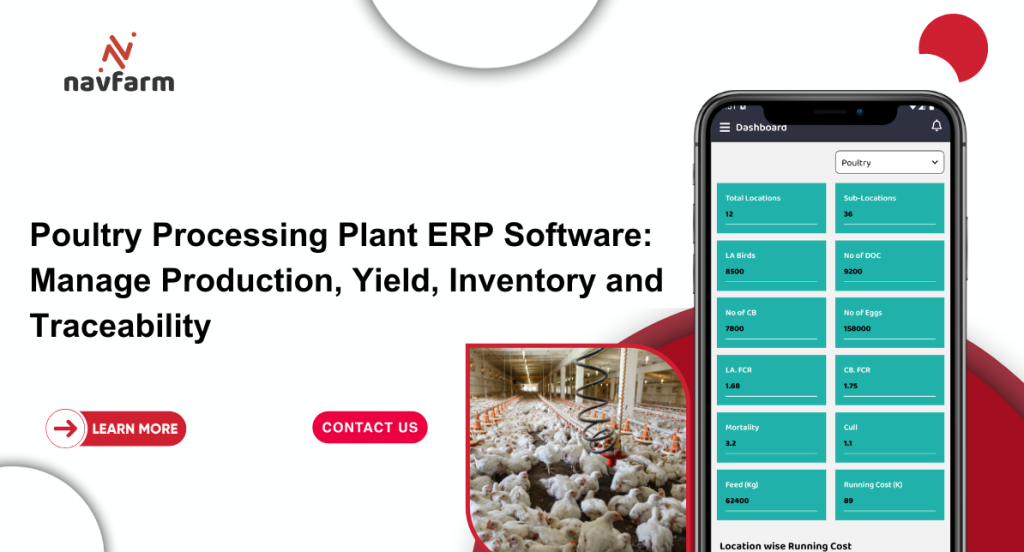
Poultry Processing Plant ERP Software: Manage Production, Yield, Inventory and Traceability

Book a Free Demo

A Processing Plant Needs More Than Production Records

A poultry processing plant handles large volumes of birds every day.

Birds arrive from farms.

They are weighed, processed, graded, chilled, cut and packed.

Different products are produced from the same bird.

Some material becomes finished products.

Some becomes by products.

Some is lost during processing.

Some products go into cold storage while others are dispatched directly to customers.

Every stage affects the final production cost and profitability.

This is why processing plants need accurate information from the moment birds enter the plant until the finished products leave the facility.

Live Bird Receiving Is the First Important Check

The processing process starts with live bird receiving.

The plant needs to know where the birds came from, which farm or batch they belong to and how many birds have arrived.

Important information can include:

Farm

Batch

Breed

Number of birds

Live weight

Average bird weight

Arrival time

Vehicle details

Processing schedule

This information becomes the starting point for production and traceability.

Live Weight Should Be Compared with Processed Weight

Weight is one of the most important measures in poultry processing.

The plant receives live birds and converts them into different products.

Management needs to understand how much finished product is being recovered from the live weight received.

For example, if a batch arrives with a live weight of 10,000 kg, the plant should be able to track how that weight is distributed after processing.

The system should show the weight of:

Whole birds

Breast meat

Legs

Wings

Other cuts

By products

Waste

This provides a clear picture of the processing yield.

Yield Is One of the Most Important Processing KPIs

Two processing plants may receive the same quantity of live birds but produce different results.

One may achieve better yield because of better processing practices.

Another may generate higher losses because of trimming, handling or equipment issues.

Yield should therefore be monitored by:

Farm

Batch

Processing date

Product

Shift

Line

Customer specification

Comparing actual yield with expected yield helps management identify where production performance needs attention.

Batch Traceability Should Continue Through Processing

A poultry processing plant should be able to trace finished products back to their source.

If a customer raises a quality concern about a packed product, the business should be able to identify:

Which processing batch produced it

Which farm supplied the birds

Which flock was involved

When the birds arrived

When they were processed

Which production line was used

Which packing batch was created

Where the finished product was dispatched

This becomes much easier when traceability is maintained throughout the processing cycle.

Different Products Need Different Production Records

A single bird can result in several finished products.

Depending on the plant, products may include:

Whole chicken

Breast

Leg

Thigh

Drumstick

Wings

Boneless products

Marinated products

Further processed products

By products

Each product has its own weight, production quantity, cost and selling price.

The system should therefore maintain production records at product level rather than treating the entire batch as one item.

Cut Up Production Needs Accurate Recording

Cut up operations can generate a large number of products from one processing batch.

Small differences in cutting and trimming can affect yield.

Production teams should be able to record actual output and compare it with expected output.

This helps answer practical questions.

Which product is generating the highest yield?

Where is excessive trimming taking place?

Which shift is producing better results?

Is the actual output matching the production plan?

These answers can help improve both production efficiency and profitability.

Cold Storage Is Part of the Production Process

Finished poultry products often move into cold storage before dispatch.

The business needs to know what is available and where it is stored.

Stock visibility should include:

Product

Batch

Production date

Expiry or use by date

Quantity

Weight

Storage location

Customer allocation

Keeping this information updated helps reduce stock errors and makes dispatch planning easier.

Expiry Management Is Critical

Poultry products have a limited shelf life.

A product sitting in cold storage for too long can become a financial loss.

The system should help identify products approaching their expiry date so that the sales and dispatch teams can plan accordingly.

This becomes especially important when the plant handles hundreds of products and multiple production batches.

Customer Orders Should Be Connected with Production

Processing should not operate independently from sales.

If the business has confirmed orders for specific products, production should know what needs to be produced.

For example, a customer may require a certain quantity of breast meat, wings and drumsticks for delivery on a particular date.

Production planning should consider those requirements while scheduling processing.

This reduces the risk of producing the wrong product mix.

Production Planning Should Consider Available Birds

The processing schedule depends on the birds available from farms.

If the plant plans production without considering farm batches and expected bird availability, the schedule can become difficult to maintain.

A connected system can help planners review:

Birds ready for processing

Expected farm depletion

Available live weight

Customer demand

Processing capacity

Cold storage capacity

Planned dispatch

This creates a more realistic processing plan.

Quality Checks Should Happen Throughout Processing

Quality should not be checked only after packing.

Checks can be performed at different stages.

Live bird receiving

Processing

Cutting

Chilling

Packing

Cold storage

Dispatch

Depending on the product, checks may include weight, temperature, appearance, packaging and other quality requirements.

Recording these results against the relevant batch makes investigations easier when an issue occurs.

By Products Should Not Be Ignored

Processing generates more than finished meat products.

There may be feathers, blood, offal, bones, fat and other by products depending on the process.

These materials may have commercial value.

If they are not recorded properly, the plant loses visibility over part of its output.

Recording by products also helps management understand the complete yield from each processing batch.

Processing Cost Should Be Linked with Production

Knowing production quantity is not enough.

Management also needs to know the cost of producing it.

Processing cost can include:

Live bird cost

Labour

Power

Water

Packaging

Cold storage

Processing overheads

Transportation

Wastage

By product recovery

When production and finance information are connected, management can calculate a more realistic cost for each finished product.

Processing Plant Needs One View of the Business

A processing plant involves many departments.

Farm operations supply the birds.

Procurement manages materials.

Production processes the birds.

Quality checks the products.

Warehouse manages cold storage.

Sales manages customer orders.

Dispatch handles deliveries.

Finance records costs and revenue.

When each department works with separate files, information gaps are common.

A connected poultry processing ERP helps bring these activities together.

How NAVFarm Supports Poultry Processing

NAVFarm can connect poultry processing operations with farm management, inventory, sales, procurement and finance.

Processing batches can remain linked with the source farm and flock.

Live bird receiving can be recorded against the relevant batch.

Production output can be recorded by product and weight.

Yield can be compared with expected production.

By products and processing losses can be accounted for.

Finished goods can move into inventory with batch and expiry information.

Customer orders can be connected with production and dispatch.

Because NAVFarm works with Microsoft Dynamics 365 Business Central, processing information can also be connected with purchasing, inventory, sales and financial transactions.

This gives management a clearer view of production performance and the financial result of each processing operation.

Better Processing Control Starts with Better Information

A poultry processing plant can handle thousands of birds every day, but production volume alone does not determine profitability.

Yield matters.

Product mix matters.

Processing loss matters.

Cold storage matters.

Customer demand matters.

Production cost matters.

When these areas are connected, management can understand what is happening on the processing floor and how it affects the business.

That is the role of a poultry processing ERP system.

It should not simply record production.

It should help the business control production, improve yield, maintain traceability and make better decisions.

Production Planning Should Start with Customer Demand

A processing plant should not plan production only on the basis of how many birds are available.

Customer demand should also be considered.

If confirmed orders require more breast meat than wings, the production plan should reflect that requirement.

The same applies to whole birds, boneless products, marinated products and other processed items.

A demand based production plan helps the plant produce the right product mix instead of creating excess stock of products that may move slowly.

Customer Orders Can Be Used For Processing Planning

Customer orders provide useful information for production teams.

The system can show:

Customer

Product

Required quantity

Required weight

Delivery date

Available finished stock

Quantity still to be produced

This gives the production team a clearer picture of what needs to be processed and when.

It also helps sales teams understand whether current production and inventory can support committed deliveries.

Live Bird Availability Should Be Considered

Production planning also depends on the availability of birds.

Farm batches have different ages and weights.

Some batches may be ready for processing while others still need additional growing time.

A processing plan should therefore consider expected farm depletion and available bird weight.

This helps the plant prepare its processing schedule based on realistic supply rather than assumptions.

Processing Capacity Can Affect the Plan

Every plant has a practical processing capacity.

There may be limits on:

Processing line capacity

Cold storage capacity

Cutting capacity

Packing capacity

Labour availability

Shift availability

Vehicle availability

A production plan that ignores these limitations may look good on paper but become difficult to execute.

The planning process should consider available capacity before confirming production schedules.

Yield Should Be Measured Against Expected Output

Every processing batch has an expected yield.

Actual output should be compared with that expectation.

For example, if a batch is expected to produce a particular quantity of breast meat but actual output is significantly lower, the difference should be investigated.

The reason could be:

Bird weight variation

Processing method

Cutting loss

Trimming

Quality rejection

Equipment settings

Operator performance

Regular yield analysis helps management identify recurring losses.

Product Mix Can Change Processing Profitability

Not every product contributes the same margin.

The value of breast meat may be different from wings or other cuts.

Some customers may pay a premium for specific products.

Others may require lower priced products in large quantities.

For this reason, management should be able to review production and sales together.

The system should help compare:

Production quantity

Selling price

Processing cost

Yield

Customer demand

Margin

This makes it easier to understand which products and customer orders are commercially attractive.

Packaging Should Be Part of Production Planning

Processing does not end when the product is cut.

Products also need suitable packaging.

Different customers may require different:

Pack sizes

Labels

Packaging material

Product descriptions

Barcodes

Customer markings

If packaging material is not available, production may be completed but dispatch can still be delayed.

Linking packaging requirements with production planning helps avoid this situation.

Cold Storage Needs Accurate Stock Information

Cold storage inventory changes continuously.

Products enter after processing.

Products move between locations.

Orders reserve stock.

Dispatch removes stock.

Returns may come back.

Without accurate records, the physical stock and system stock can quickly become different.

A processing ERP should provide visibility into stock by product, batch, weight and location.

Batch Wise Stock Makes Traceability Easier

Suppose a customer reports a problem with a particular product.

The business should be able to identify the affected batch quickly.

Batch wise inventory helps trace:

Production date

Processing batch

Source farm

Product

Packing batch

Storage location

Customer dispatch

This reduces the time required for investigation and makes product recall management easier if required.

Temperature Monitoring Is Important

Temperature has a direct impact on poultry product quality.

Temperature should be monitored during relevant stages of processing, storage and transportation.

Records can include:

Processing temperature

Chilling temperature

Cold room temperature

Dispatch temperature

Transport temperature

If a temperature issue occurs, the business should be able to identify the affected batch and take appropriate action.

Quality Rejection Should Be Recorded

Not every processed product will meet the required standard.

Some products may be rejected because of:

Weight variation

Appearance

Packaging damage

Temperature

Foreign material

Processing defects

Customer specific requirements

Recording rejected quantities helps management understand the real production loss.

Quality rejection should also be reflected in inventory and costing so that the financial impact is not missed.

Rework Should Be Tracked

Some rejected products can be reworked rather than discarded.

For example, a product may require repacking, trimming or another processing step.

Rework consumes labour, time and other resources.

If rework is not recorded, the actual cost of production remains hidden.

Tracking rework by batch and product helps management understand where additional costs are being generated.

Labour and Shift Performance Can Affect Output

Processing plants often operate across multiple shifts.

Performance can vary between shifts depending on manpower, experience, equipment condition and production volume.

Useful reports can compare:

Production quantity by shift

Yield by shift

Rejection by shift

Rework by shift

Labour hours

Processing cost

This gives management a better understanding of production performance.

Procurement Should Be Linked with Processing Requirements

A processing plant needs a regular supply of materials.

Packaging material is one example.

Other requirements may include cleaning materials, processing consumables, spare parts and other operational items.

Procurement should have visibility into expected production so that material requirements can be planned in advance.

This reduces emergency purchases and production delays caused by missing materials.

Inventory Should Reflect Actual Production

When processing is completed, the finished products should be reflected in inventory according to actual production.

This may include different products from the same processing batch.

For example:

Whole birds

Breast

Legs

Wings

Boneless products

By products

Each product can have its own quantity, weight, batch and storage location.

This provides a more accurate picture of available stock.

Sales Should Know What Is Actually Available

Sales teams need reliable information before confirming customer orders.

If the system shows that 2,000 kg of a particular product is available, sales should be able to trust that number.

The same information should show whether the stock is:

Available

Reserved

Under quality inspection

Allocated to another order

Expired

Ready for dispatch

This helps reduce order commitments based on incorrect stock information.

Dispatch Should Follow Product and Batch Requirements

Dispatch is the final stage before the product reaches the customer.

The team should verify:

Customer

Order

Product

Quantity

Weight

Batch

Packaging

Temperature

Vehicle

Delivery location

Once the vehicle leaves the plant, correcting an incorrect shipment becomes much more difficult.

Connecting dispatch with sales, inventory and production reduces these errors.

Processing Data Should Be Available to Finance

Finance needs more than sales invoices.

It needs to understand the cost behind those sales.

Processing data can help calculate:

Live bird cost

Processing cost

Packaging cost

Cold storage cost

Transportation cost

Wastage

Rework

By product recovery

When these figures are connected with accounting information, management gets a better understanding of actual profitability.

One Processing Batch Can Affect Many Business Areas

A single processing batch can create information for several departments.

Farm management needs the source batch.

Production needs the processing details.

Quality needs inspection records.

Warehouse needs finished stock.

Sales needs availability.

Dispatch needs delivery information.

Finance needs cost and revenue.

Keeping these records connected prevents different departments from working with different versions of the same information.

NAVFarm Can Bring These Processes Together

NAVFarm can connect processing activities with the wider poultry business.

The processing team can work with information received from farms.

Production can record live bird receiving, processing output, yield and losses.

Quality teams can record inspection results.

Warehouse teams can manage finished products by batch and location.

Sales teams can view customer orders and available stock.

Procurement can plan packaging and other requirements.

Finance can connect production and sales information with costs and accounting.

With Microsoft Dynamics 365 Business Central as the underlying business platform, the processing plant can work with the same core business information used across procurement, inventory, sales and finance.

A Processing Plant Needs Control from Receiving to Dispatch

The processing operation is a chain.

If one part is not controlled, the effect can be seen somewhere else.

Poor bird receiving records can affect traceability.

Incorrect production records can affect inventory.

Poor yield can affect profitability.

Incorrect stock can affect sales.

Delayed dispatch can affect customer relationships.

A connected processing management system helps management see these links and take action before small issues become larger problems.

Processing Performance Should Be Reviewed Every Day

A processing plant cannot wait until the end of the month to find out that yield has fallen or production costs have increased.

Daily performance review helps management identify problems while there is still time to correct them.

Important daily measures can include:

Live birds received

Live weight

Processed weight

Finished product quantity

Yield percentage

Rejection quantity

Rework quantity

By product quantity

Processing loss

Production cost

These figures give the production team a clear picture of what happened during the shift.

Yield Reports Help Find Hidden Losses

Yield is one of the most important measurements in a poultry processing business.

A small difference in yield can become a significant financial loss when thousands of birds are processed every month.

Yield should therefore be reviewed by:

Farm

Batch

Breed

Bird weight

Processing date

Shift

Product

Production line

This allows management to identify where yield is consistently lower than expected.

Farm Performance Can Be Compared with Processing Results

Processing data can also provide useful feedback to farm teams.

For example, if birds from one farm consistently produce lower processing yield, management can investigate whether the reason is related to:

Bird weight

Uniformity

Flock condition

Transport

Processing handling

Farm management

This creates a useful connection between farm performance and processing results.

The processing plant is not only a place where birds are converted into products. It can also provide information that helps improve farm performance.

Traceability Should Work from Customer Back to Farm

Traceability becomes particularly important when a customer raises a quality concern.

The business should be able to start with the customer’s product and move backwards through the supply chain.

Customer order

Dispatch

Finished product batch

Packing batch

Processing batch

Farm batch

Source flock

This backward traceability can significantly reduce investigation time.

The same information can also be used for forward traceability.

If a problem is identified with a particular farm batch, the business can identify which products and customers were affected.

Product Recall Requires Fast Information

No processing business wants to deal with a product recall.

But if one becomes necessary, speed matters.

The business needs to identify affected batches and customers quickly.

A connected system can help determine:

Which batch is affected

How much was produced

How much remains in stock

Which customers received the product

How much was dispatched

Where the remaining stock is stored

This information helps management respond in a controlled manner.

Quality Documents Should Stay with the Batch

Quality records should not be separated from production records.

Inspection results, temperature records, laboratory reports and other documents should remain connected with the relevant batch.

When a customer asks for supporting information, the quality team should not have to search through emails and paper files.

The information should be available with the batch history.

Expiry And Shelf Life Need Daily Attention

Finished poultry products have a limited shelf life.

Stock that remains in cold storage for too long can become difficult to sell.

The system should help identify stock approaching its expiry date.

This allows sales and dispatch teams to prioritise suitable products and reduce avoidable losses.

Stock can be reviewed by:

Product

Batch

Production date

Expiry date

Location

Customer allocation

This gives warehouse teams better control over cold storage inventory.

Production Planning Should Use Available Capacity

A processing plant may have strong customer demand but limited processing capacity.

Management needs to understand how much the plant can actually process during a particular period.

Capacity planning can consider:

Processing line capacity

Available shifts

Labour

Cold storage

Packing capacity

Maintenance schedules

Expected bird availability

Customer orders

This helps create production schedules that are realistic and achievable.

Maintenance Can Affect Processing Schedules

Processing equipment needs regular maintenance.

If maintenance is ignored, an unexpected breakdown can stop production and affect customer deliveries.

Production planning should therefore consider planned maintenance periods.

Management should be able to see when equipment will be unavailable and adjust production schedules accordingly.

Processing Cost Should Be Reviewed by Product

Not all products cost the same to produce.

The cost of producing a particular cut can be affected by:

Live bird cost

Yield

Labour

Processing time

Packaging

Cold storage

Rework

Quality rejection

Transportation

Management should be able to compare actual cost with selling price and understand the margin generated by each product.

This information helps sales and management make better pricing decisions.

Customer Specific Pricing Can Be Connected with Processing

Different customers may have different prices for the same product.

Pricing can depend on:

Customer

Product

Quantity

Contract

Market price

Packaging requirement

Delivery location

Processing requirement

Keeping pricing information connected with sales and production helps the business understand the commercial impact of each order.

Processing And Finance Should Work from The Same Numbers

One of the common problems in manufacturing businesses is the difference between operational and financial reports.

Production may show one quantity.

Warehouse may show another.

Finance may use a different figure for costing.

A connected system reduces these differences.

Production records feed inventory.

Inventory supports sales and dispatch.

Sales creates financial transactions.

Purchasing records costs.

Finance receives the resulting accounting information.

This creates a clearer connection between what happens on the processing floor and what appears in the financial statements.

Mobile Data Entry Can Improve Processing Records

Processing teams spend most of their time on the production floor.

They should not have to wait until they return to an office before recording important information.

Mobile data entry can be used for:

Bird receiving

Weight recording

Production output

Quality inspection

Temperature checks

Rejection

Rework

Packing

Dispatch

Immediate recording reduces the time between the physical activity and the information becoming available to management.

Dashboards Give Management a Clear View

A processing plant dashboard can bring the most important information together.

Management may want to see:

Birds processed today

Live weight

Processed weight

Yield

Production quantity

Rejection

Rework

Cold storage stock

Orders pending

Dispatches

Production cost

Margin

The dashboard should highlight areas that require attention rather than simply displaying large amounts of data.

How NAVFarm Supports Poultry Processing Operations

NAVFarm is designed to connect poultry operations across farms, hatcheries, feed, processing, inventory, sales, procurement and finance.

For processing plants, the system can support the complete flow from live bird receiving to finished product dispatch.

Farm and batch information can remain connected with processing records.

Production teams can record live weight, processed weight, product output and yield.

Quality teams can maintain inspection information.

Finished products can be managed by batch and storage location.

Sales orders can be linked with available production and inventory.

Dispatch information can remain connected with customer orders.

Processing costs can be reviewed alongside production and sales information.

Because NAVFarm works with Microsoft Dynamics 365 Business Central, the processing operation can be connected with purchasing, inventory, sales and finance instead of being managed as a separate system.

Frequently Asked Questions

What is Poultry Processing Plant ERP Software?

Poultry Processing Plant ERP Software helps poultry processing businesses manage live bird receiving, production, yield, quality, finished goods, cold storage, customer orders, dispatch and financial information from one connected system.

Can poultry processing software track yield?

Yes. Live bird weight, processed weight, finished product quantity, by products and processing losses can be recorded and used to calculate actual yield.

Can the system track products back to the farm?

Yes. Batch based traceability can connect finished products with the processing batch, farm, flock and other relevant production information.

Can poultry processing ERP manage cold storage?

Yes. Finished products can be managed by product, batch, quantity, weight, storage location and expiry information.

Can customer orders be connected with processing?

Yes. Customer orders can be considered during production planning so that the plant can plan the required product mix and quantities.

Can NAVFarm connect processing with finance?

Yes. NAVFarm works with Microsoft Dynamics 365 Business Central, allowing processing, inventory, purchasing, sales and finance to work with connected business information.

A Processing Plant Needs Visibility Across the Complete Operation

A poultry processing business is not simply about processing birds.

It is about converting live birds into saleable products while controlling yield, quality, inventory, cost and delivery.

Every kilogram matters.

Every processing loss matters.

Every rejected product affects profitability.

Every delayed delivery affects customer relationships.

When farm information, processing, quality, inventory, sales and finance are connected, management gets a much clearer view of the business.

NAVFarm provides a connected platform for poultry businesses that want to manage these activities together rather than relying on separate spreadsheets and disconnected systems.

For a growing processing operation, better information can make a significant difference to production control, traceability, inventory accuracy and profitability.

Book a Free Demo