Pradeep
By NAVFarm Team| AgriTech & Poultry Innovation | 7 min read
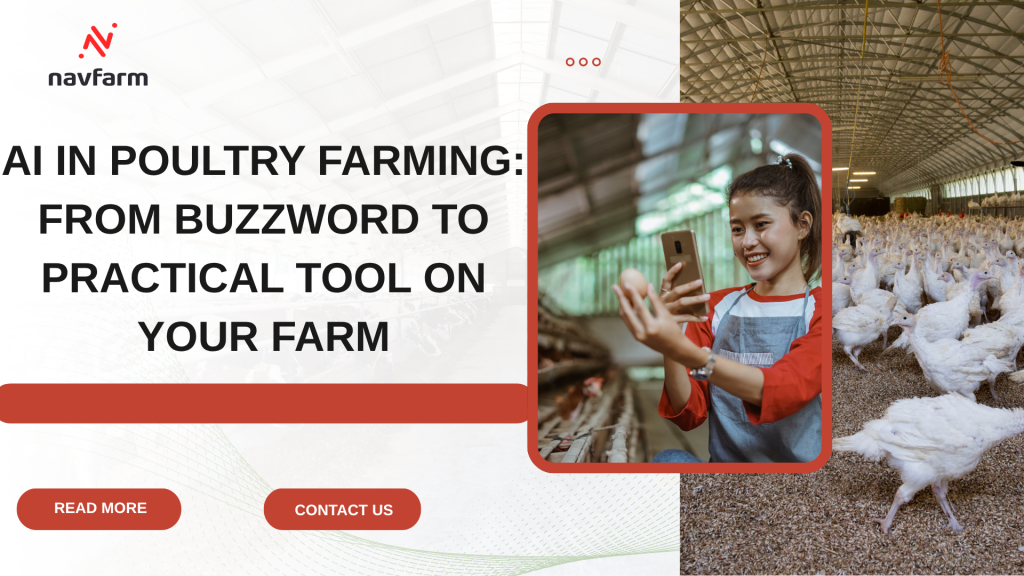
The term AI gets mentioned so frequently in agriculture that it often feels overused. It appears in product brochures, industry events, and government initiatives. Yet if you ask many farmers what AI is currently doing on their farms, the answer is often very little.
That situation is beginning to change. However, the biggest benefits are not coming from futuristic robots or autonomous machines. Instead, modern farms are using AI for something far more practical: helping farmers understand and act on their own data faster than ever before.
With advanced Poultry Farm Management Software, farm operators no longer need a dedicated analyst to investigate performance issues. They can simply ask questions and receive meaningful insights in seconds.
The Real Problem AI Solves on Poultry Farms
Today’s poultry farms generate enormous amounts of information. Mortality records, feed consumption, water intake, body weight measurements, environmental readings, and vaccination schedules accumulate rapidly across multiple sheds and batches.
Collecting data has never been the challenge. The real challenge is converting that information into actionable decisions quickly enough to improve outcomes.
Traditionally, comparing flock performance required manually gathering reports from multiple sources. If a manager wanted to understand why one shed achieved a better FCR than another, the process could take hours or even days. By the time conclusions were reached, the production cycle had often moved forward.
Modern AI-powered Poultry Farm Management Software removes this delay by allowing users to ask questions in plain language and receive instant analysis based on existing farm records.
How AI-Assisted Analysis Works in Practice
Consider a common farm scenario. A manager notices that feed intake in Shed 4 has declined by nearly 8% over the past three days.
Without AI, the team would likely review records manually, consult specialists, and begin a lengthy investigation.
With a smart Poultry Management Solution, the process becomes much faster:
- The system automatically identifies that a KPI threshold has been exceeded.
- The manager asks, “Why has feed intake dropped in Shed 4 this week?”
- AI reviews historical batch data, vaccination schedules, environmental conditions, and breed performance records.
- Within moments, it highlights that overnight temperatures remained above optimal levels for several days and that similar batches previously experienced feed suppression during heat stress.
- The veterinary assessment can still proceed, but the team already has a strong starting point for investigation.
This is not a future concept. It is a practical application of AI using data that farms already collect every day.
Bird Health Monitoring With AI
One of the most valuable uses of AI in poultry production is visual bird health monitoring. Early signs of disease often appear through changes in posture, movement, feather condition, and flock behavior. Detecting these signs consistently across thousands of birds can be extremely difficult.
Using intelligent image analysis within a Poultry Farm Management Platform can help teams:
- Detect visible symptoms of common diseases and nutritional issues.
- Suggest potential causes based on age, breed, and flock history.
- Identify whether the issue appears isolated or widespread.
- Recommend whether immediate veterinary attention may be required.
AI does not replace professional veterinary expertise. Instead, it provides a valuable first level of assessment that helps teams respond faster and more effectively.
Why Voice-Based Data Entry Matters
Voice-enabled data entry may seem like a small feature, but it can significantly improve farm operations.
Many poultry workers spend their day in busy, hot environments where typing information into a device is inconvenient. As a result, records are often delayed or completed from memory, reducing accuracy.
With voice-enabled Farm Management Software, workers can simply record observations such as:
“Shed 2, morning, mortality 3, feed consumed 480 kilos, water normal.”
The system captures and stores the information automatically.
Benefits include:
- Real-time data recording at the point of observation.
- Improved accuracy and consistency.
- Higher adoption among farm staff.
- Better quality data for future analysis.
Reliable data collection forms the foundation of every successful AI system.
Offline Mobile Access Makes Farm Technology Practical
A poultry farm is not an office environment. Internet connectivity can be inconsistent, especially inside sheds and remote farm locations.
That is why an effective Poultry Farm Management Software must function offline.
An offline-first approach allows:
- Data to be saved instantly on the device.
- Automatic synchronization when connectivity returns.
- Managers to access updated information without manual intervention.
- Continuous operation without disruption.
This practical design ensures technology supports daily farm activities instead of creating additional challenges.
Security and Compliance for Modern Poultry Operations
Farm data includes critical business information such as flock performance, supplier details, veterinary records, and traceability documentation.
Before selecting a management platform, poultry businesses should evaluate:
- Where data is stored.
- What security measures protect the information.
- Who has access to farm records.
- Whether data can be exported if required.
- Which compliance certifications the provider maintains.
Platforms built on Microsoft Azure provide enterprise-grade security, regular auditing, and compliance frameworks that support modern food safety and traceability requirements.
Is AI the Right Choice for Your Farm?
The effectiveness of AI depends heavily on the quality of available data. Inaccurate or incomplete records will naturally produce unreliable recommendations.
For most poultry operations, the best approach is:
- Establish consistent data collection across all sheds and batches.
- Implement automated KPI monitoring and alerts.
- Introduce AI-powered analysis once reliable data is available.
- Use AI insights to support decision-making rather than replace human expertise.
Farms that build strong data foundations before adopting advanced analytics typically achieve better long-term results than those that invest in technology without proper preparation.
Bottom Line
AI is no longer a future concept in poultry farming. It is already helping farms improve productivity, identify performance issues, monitor bird health, and make faster decisions.
The greatest value comes when AI is integrated into a complete Poultry Farm Management Software ecosystem that combines accurate data collection, automated alerts, traceability, and mobile accessibility.
The farms that gain the most from AI will be those that focus on building strong systems today—not because of industry hype, but because they understand the importance of data-driven decision-making.
About NAVFarm
NAVFarm is a comprehensive Poultry Farm Management Software built on Microsoft Azure and available through Microsoft Marketplace as a certified ISV solution. Key features include AI-powered analytics, voice-based data capture, bird health image analysis, flock and breed management, KPI monitoring, complete farm-to-fork traceability, and offline mobile functionality.
Learn more or request a demo by visiting: https://www.navfarm.com/poultry/
Prudence Technology Limited
Agri ERP & Farm Management Software Experts
Website: www.consultingprudence.com
Mail: paul.young@prudencesoftech.com
Call: +91-8789573094