Pradeep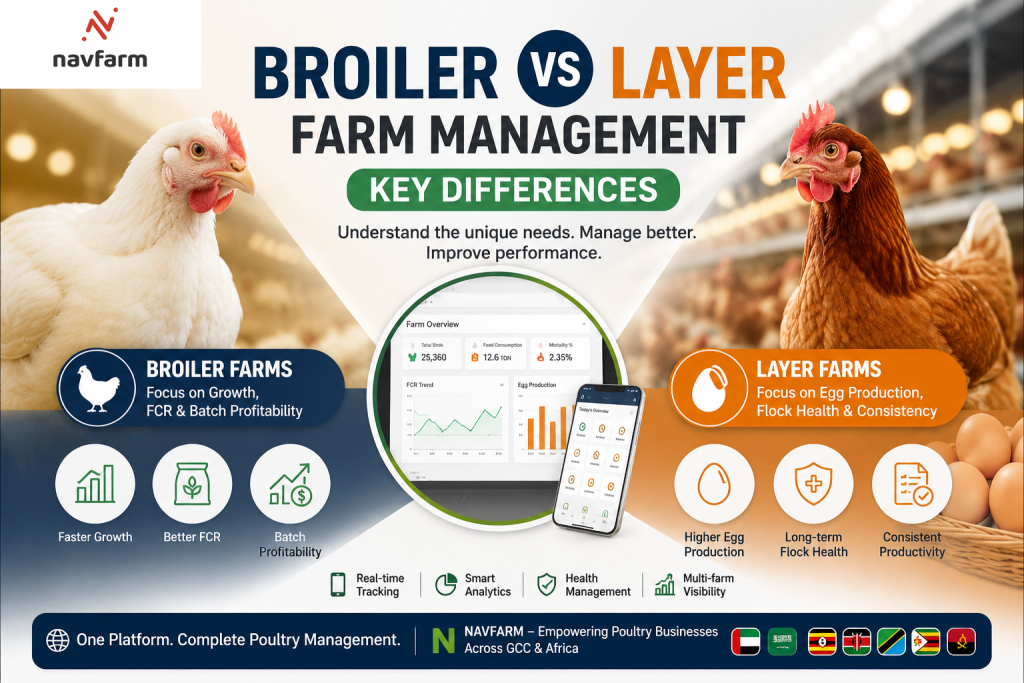
Poultry farming is one of the fastest-growing sectors in modern agriculture, but managing a broiler farm is completely different from managing a layer farm. Although both fall under poultry production, their operational goals, feeding strategies, production cycles, and management requirements vary significantly.
Understanding these differences is essential for improving productivity, reducing operational losses, and increasing long-term profitability.
Across the UAE, GCC, and African markets such as Uganda, Kenya, Tanzania, Zimbabwe, and Angola, poultry businesses are increasingly adopting digital farm management systems to improve operational visibility and farm efficiency.
Modern platforms like Navfarm are helping poultry businesses gain real-time insights into feed management, flock performance, mortality tracking, egg production, and overall profitability.
Understanding the Difference Between Broiler and Layer Farming
Broiler Farming
Broiler farming focuses on raising chickens for meat production. The primary objective is to achieve rapid bird growth, efficient feed conversion, and timely market readiness.
Broiler farms mainly focus on:
- Faster weight gain
- Better Feed Conversion Ratio (FCR)
- Mortality reduction
- Batch profitability
Since production cycles are short, broiler farms require close monitoring of feed management, environmental conditions, and flock health.
Modern ERP for Poultry Farm solutions help broiler farms monitor production batches, optimize feed usage, and improve operational efficiency through centralized dashboards and real-time tracking.
Layer Farming
Layer farming focuses on long-term egg production instead of meat production.
The key objectives of layer farming include:
- Consistent egg production
- Long-term flock health
- Egg quality management
- Sustainable production efficiency
Layer farms require continuous monitoring of nutrition, bird health, laying consistency, and environmental stress factors to maintain stable production levels.
Key Differences Between Broiler and Layer Farm Management
| Management Area | Broiler Farm | Layer Farm |
|---|---|---|
| Primary Goal | Meat production | Egg production |
| Production Cycle | Short-term | Long-term |
| Key Performance Metric | Weight gain & FCR | Egg production & Lay % |
| Feed Focus | Rapid growth | Sustained productivity |
| Bird Lifecycle | Typically 35–45 days | 70+ weeks |
| Monitoring Focus | Growth, mortality, FCR | Egg quality, laying rate, flock health |
| Revenue Model | Batch-based sales | Continuous egg sales |
Feed Management: Different Operational Priorities
Feed is one of the largest operational expenses in poultry farming, but feed management strategies differ significantly between broiler and layer farms.
Feed Management in Broiler Farms
Broiler feed management focuses on:
- Rapid weight gain
- Better feed conversion efficiency
- Reduced feed wastage
Modern poultry platforms help farms:
- Track feed consumption by batch
- Monitor bird growth trends
- Analyze FCR performance in real time
- Identify feed inefficiencies quickly
Digital farm systems integrated with livestock management software also help businesses optimize feed allocation and monitor overall farm productivity more effectively.
Feed Management in Layer Farms
Layer farm feed management focuses on maintaining long-term egg production and flock consistency.
Layer farms closely monitor:
- Feed-to-egg ratio
- Nutritional balance
- Egg production trends
- Long-term feed efficiency
Proper feed planning directly impacts egg quality, laying consistency, and farm profitability.
Production Tracking and Farm Visibility
Broiler Farm Production Tracking
Broiler operations require close monitoring of:
- Batch-wise production
- Weight gain trends
- Mortality rates
- Market readiness forecasting
Real-time production visibility helps broiler farms improve productivity and reduce operational losses.
Layer Farm Production Tracking
Layer farms require continuous monitoring of:
- Daily egg production
- Lay percentage
- Egg grading and quality analysis
- Long-term flock performance
Consistent monitoring helps layer farms maintain stable production and improve profitability.
Health and Biosecurity Management
Health management is critical for both broiler and layer farms, but the operational priorities are different.
Health Management in Broiler Farms
Broiler farms mainly focus on:
- Disease prevention
- Mortality reduction
- Environmental monitoring
- Rapid outbreak response
Because broilers are raised in dense populations with short production cycles, even small health issues can lead to major financial losses.
Health Management in Layer Farms
Layer farms focus more on:
- Long-term flock health
- Vaccination scheduling
- Stress management
- Maintaining production consistency
Health problems in layer farms often result in reduced egg production and lower operational efficiency.
Why Poultry Farms Need Digital Management Systems
Many poultry farms still depend on spreadsheets or paper-based systems, which often create operational challenges such as:
- Delayed decision-making
- Poor operational visibility
- Feed inefficiencies
- Data gaps and reporting delays
Modern poultry management systems help businesses:
- Track flock performance in real time
- Manage feed and inventory efficiently
- Monitor mortality and health trends
- Centralize operations across multiple farms
- Access farm data online and offline
Cloud-based farm management systems are especially valuable for growing poultry businesses across GCC and African markets, where scalability and operational visibility are becoming increasingly important.
The Growing Demand for Smart Poultry Farming
Poultry farming across the UAE, GCC, Uganda, Kenya, Tanzania, Zimbabwe, and Angola is becoming increasingly competitive and technology-driven.
As operational costs continue to rise, farms now require:
- Better feed optimization
- Real-time operational visibility
- Faster business decision-making
- Stronger biosecurity systems
- Centralized farm management
AI-powered poultry ERP systems are helping farms achieve these goals through automation, analytics, and intelligent operational tracking.
Smart Agriculture Beyond Poultry Farming
Today’s agribusinesses are integrating multiple farming operations through connected digital ecosystems.
Solutions like ERP software for the dairy industry help dairy businesses improve milk production management, inventory tracking, traceability, and financial reporting.
Similarly, Crop Management Software supports agricultural operations through crop planning, irrigation monitoring, productivity tracking, and farm activity management.
Aquaculture businesses can also improve operational efficiency using Aqua Management Software for water quality monitoring, feeding schedules, production cycle management, and farm analytics.
Final Thoughts
Broiler and layer farms may both belong to poultry farming, but their operational management strategies are fundamentally different.
Broiler Farms Focus On:
- Growth speed
- Feed efficiency
- Batch profitability
Layer Farms Focus On:
- Egg production consistency
- Long-term flock health
- Productivity optimization
As poultry farming continues to grow across GCC and African markets, businesses adopting smart and data-driven farm management systems will be better positioned to improve efficiency, reduce losses, and increase profitability.
Whether operating broiler farms in the UAE or layer farms across Kenya, Uganda, Tanzania, Zimbabwe, or Angola, future success will depend on real-time operational visibility, intelligent resource management, and connected farming systems.
With platforms like Navfarm, poultry businesses can improve flock performance, reduce operational inefficiencies, and build more sustainable and profitable operations.
The future of poultry farming is connected, intelligent, and data-driven.
Prudence Technology Limited
Agri ERP & Farm Management Software Experts
Short Summary
Broiler and layer farms have completely different operational goals, production cycles, and management strategies. Broiler farms focus on rapid growth and feed efficiency, while layer farms prioritize egg production consistency and long-term flock health. Modern poultry businesses are adopting digital farm management systems to improve productivity, operational visibility, and profitability. Smart poultry farming powered by AI and real-time monitoring is shaping the future of the poultry industry.
Prudence Technology Limited
Agri ERP & Farm Management Software Experts
Website: www.consultingprudence.com
Mail: paul.young@prudencesoftech.com
Call: +91-8789573094
Move from guesswork to data driven farming.